
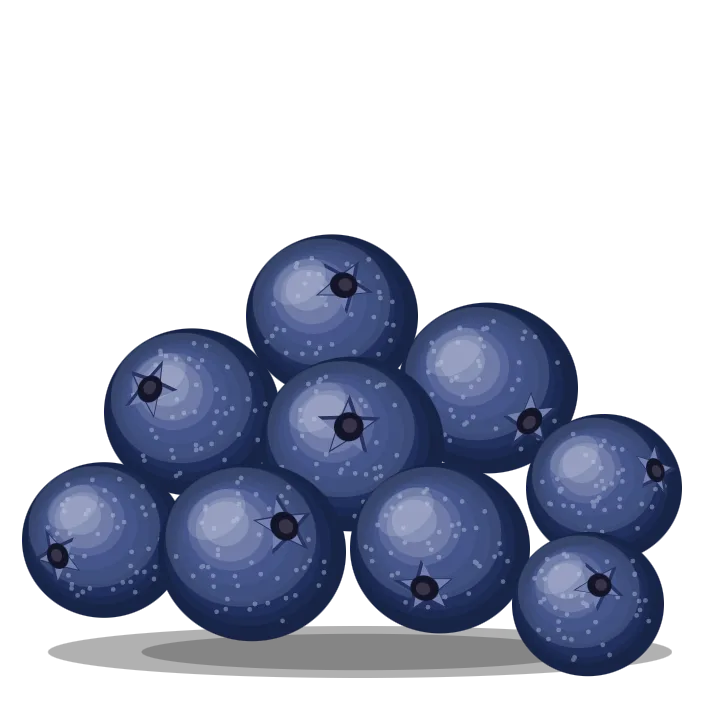
Blueberry
Vaccinium spp.
fruit
Small blue-violet berries, mild and slightly sweet, of a dwarf shrub 20 to 60 cm tall from the forests and heaths of Eurasia; the name has spread to the cultivated American species, the Quebec “bleuet”. They provide anthocyanins.
- Origin
- Forests and moors of Europe and North America
- Season (United States)
- June to September · grows in your region
- Preparation
- Eaten raw and whole, skin and seeds included, after a quick rinse; also baked in tarts, made into jam or added to pancakes. Its skin is eaten, and that is where its polyphenols sit: worth keeping, then — but under running water, rubbing it, which is what takes off most of what settles there, organic or not.
- Molecules
- Anthocyanins · Phenolic acids · Stilbenes (resveratrol)In small amounts, not counted Flavonols (quercetin) · Vitamin C
- Did you know?
- The wild bilberry stains hands, teeth and tongue blue: its pigments are in the skin and the flesh, and it was long used as a dye.