
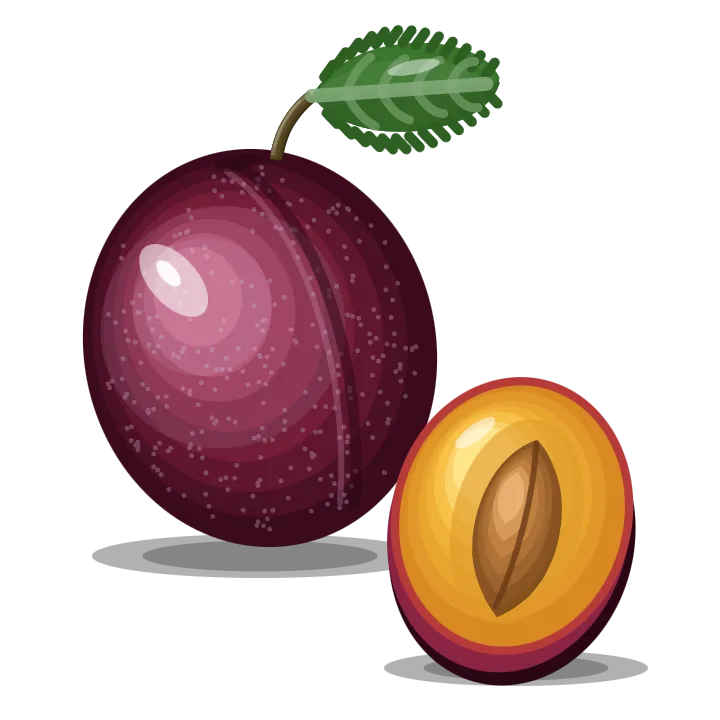
Plum
Prunus spp.
fruit
Small sweet stone fruits of the plum tree, which, contrary to what one reads, does not come from China; damson, mirabelle, greengage, and the ente plum which, dried, makes the Agen prune. It provides pectins, anthocyanins and phenolic acids.
- Origin
- Caucasus and Central Asia
- Season (United States)
- July to September · grows in your region
- Preparation
- Only the stone is left, and its kernel is not crunched. Its skin is eaten, and that is where its polyphenols sit: worth keeping, then — but under running water, rubbing it, which is what takes off most of what settles there, organic or not.
- Molecules
- Pectins · Anthocyanins · Phenolic acids · Insoluble fibersIn small amounts, not counted Flavanols and procyanidins · Vitamin K1
- Did you know?
- The ente plum is said to have come from the East at the time of the Crusades, first propagated by the Benedictine monks of Clairac; its name comes from the old French “enter”, to graft, as it is best grafted.