
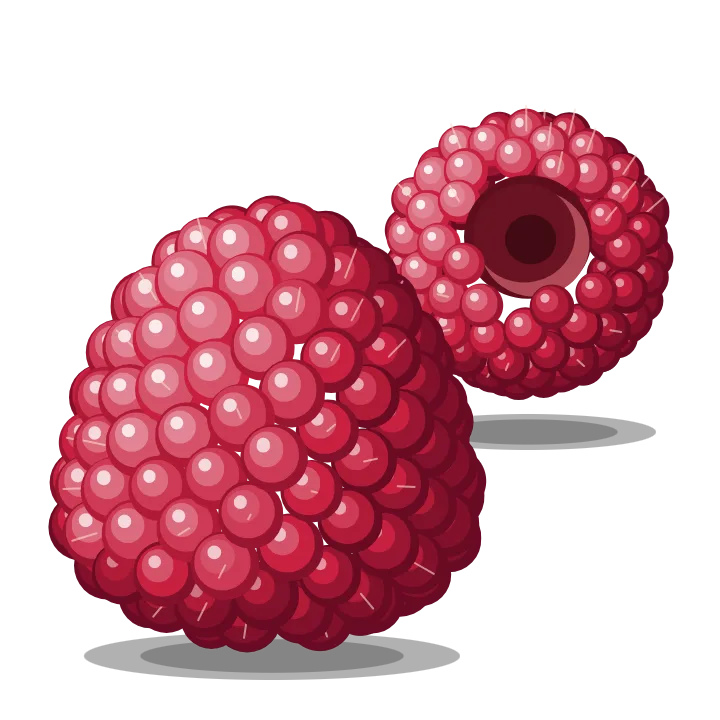
Raspberry
Rubus idaeus
fruit
Small, fragile red fruits of a shrub with stems bristling with tiny prickles, wild from Europe to Siberia; they do not keep. They provide ellagitannins, anthocyanins, fibre, and 11 to 37 mg of vitamin C per 100 g.
- Origin
- Mountain regions of Europe and Asia
- Season (United States)
- June to September · grows in your region
- Preparation
- Eaten raw and whole, tiny seeds included; rather than soaking, it gets a quick rinse just before serving, or it becomes waterlogged. Its skin is eaten, and that is where its polyphenols sit: worth keeping, then — but under running water, rubbing it, which is what takes off most of what settles there, organic or not.
- Molecules
- Anthocyanins · Ellagitannins · Insoluble fibersIn small amounts, not counted Pectins · Vitamin C · Manganese · Vitamin B8 (biotin)
- Did you know?
- Its Latin name, Rubus idaeus, “bramble of Mount Ida”, comes from a legend: it was born on Mount Ida, in Crete, where Zeus spent his childhood.