
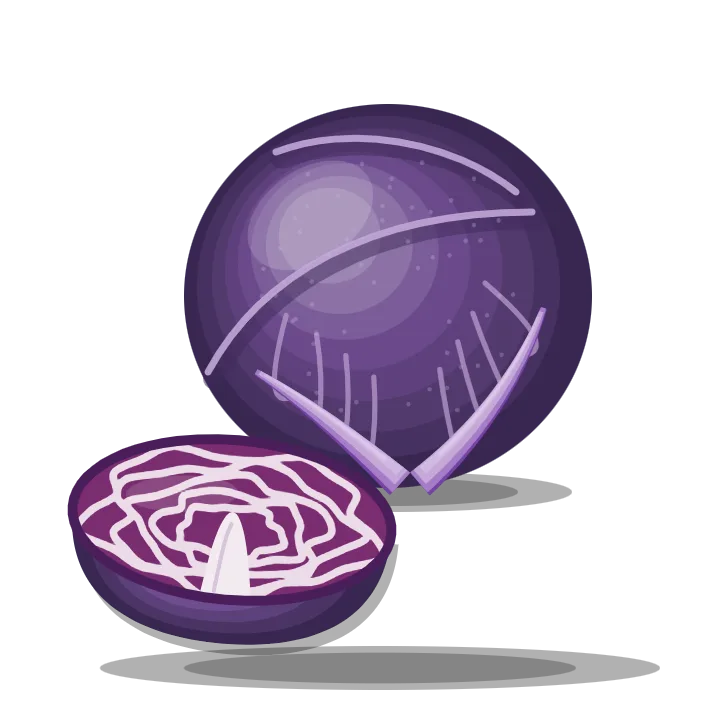
Red cabbage
Brassica oleracea var. capitata
vegetable
A headed cabbage with red-purple leaves, the same species as white cabbage, raw in salads or braised; in Germany, once cooked, it is called Blaukraut, “blue cabbage”. It provides anthocyanins, glucosinolates and vitamin C.
- Origin
- Atlantic coasts of Europe
- Season (United States)
- September to March · grows in your region
- Preparation
- The core is eaten too, thinly sliced. Its anthocyanin turns blue-gray in an alkaline medium: a splash of vinegar or lemon at the end of cooking gives it back its red. Short steaming keeps its glucosinolates; long boiling carries them off. Most of its goitrogens go with cooking, even a short one.
- Molecules
- Anthocyanins · Glucoraphanin → sulforaphane · Glucobrassicin → I3C · Vitamin C · Insoluble fibersWhat slows things down Goitrogens
- Did you know?
- Its pigment changes colour with the soil: in acid soil the cabbage grows redder, in neutral soil more purple, and in alkaline soil almost greenish-yellow.