
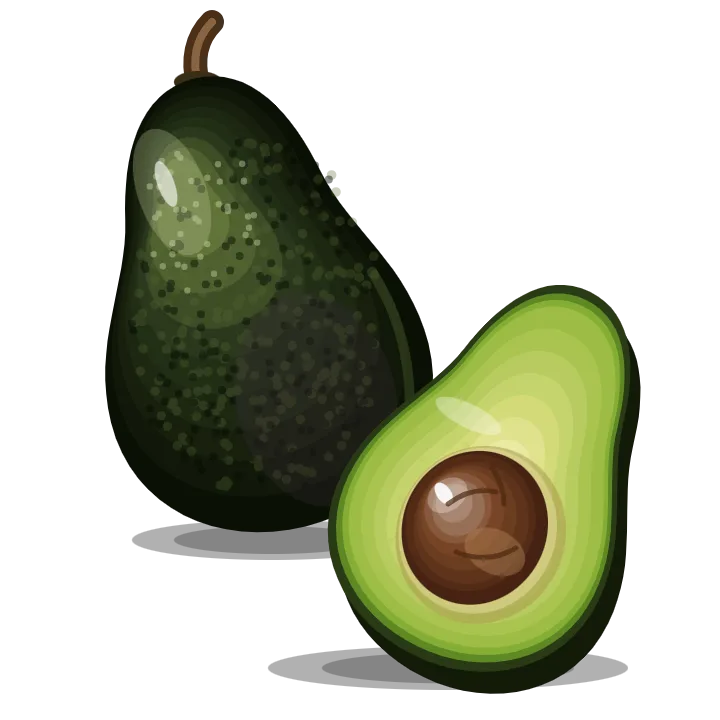
Avocado
Persea americana
fruit
The fruit of a tree from Mexico and Central America, with green flesh rich in fat, mostly monounsaturated, and in fibre: nearly 7 g per 100 g.
- Origin
- Mexico and Central America
- Season (United States)
- all year round · grows in your region
- Preparation
- The skin and pit are not eaten: the skin is tough, and the pit, despite the recipes going around, has never been recognized as a food. The dark green flesh just under the skin is the richest in carotenoids: peeling it by hand keeps far more than scooping it with a spoon.
- Molecules
- Folates (B9) · Vitamin E · Vitamin B6 · Potassium · Vitamin B3 (niacin) · Vitamin B5 (pantothenic acid) · Monounsaturated fatty acidsIn small amounts, not counted Lutein and zeaxanthin · Vitamin K1 · Magnesium · Copper · Omega-6 (linoleic acid) · Phytosterols · Chlorophyll · Choline
- Did you know?
- Its name comes from the Nahuatl ahuacatl, via the Spanish aguacate; the meaning “testicle” often attributed to it is a folk etymology, refuted by linguists. Its huge stone may have been made for vanished giants, gomphotheres and ground sloths, which swallowed the fruit whole: a debated idea, since agoutis and spectacled bears still eat it.