
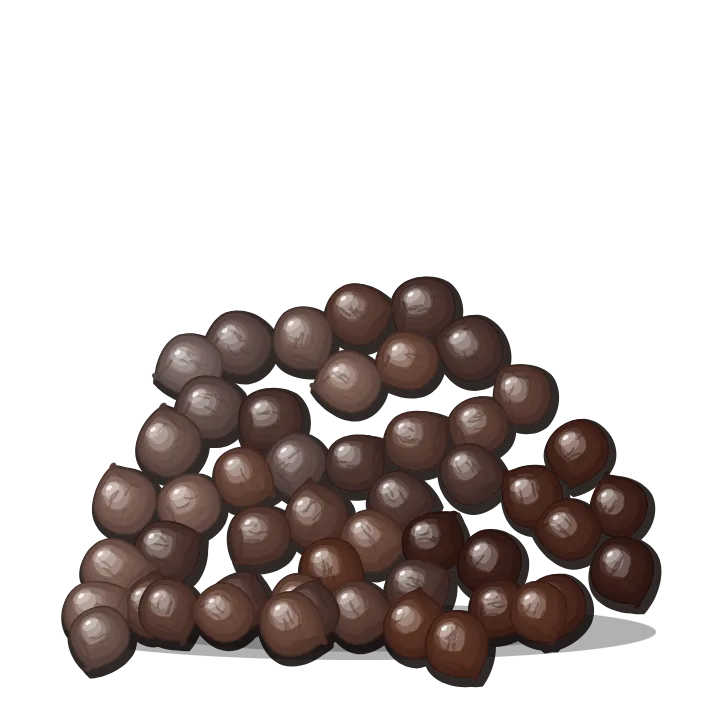
Black chickpea
Cicer arietinum
legume
Small chickpeas with a thick, rough black skin, richer in fibre than large pale chickpeas; soak them well before cooking. They provide protein, fibre, iron, zinc and folate.
- Origin
- India and Italy (ceci neri)
- Season (United States)
- all year round
- Preparation
- They soak for 12 to 24 hours, the water is discarded, then they cook for 1 to 2 hours, their skin staying firm; eaten cooked, never raw — in curry (kala chana) or salads. Soaking, sprouting or sourdough bring its phytates down — and release the zinc and iron they were holding. High in purines: to rotate rather than stack, if the ground is sensitive.
- Molecules
- Resistant starch RS1 · GOS (galacto-oligosaccharides) · Saponins · Folates (B9) · Vitamin B1 (thiamine) · Vitamin B6 · Plant iron · Zinc · Magnesium · Potassium · Copper · Manganese · Protein · Lysine · Tryptophan · Vitamin B3 (niacin) · Vitamin B5 (pantothenic acid) · Phosphorus · Molybdenum · Choline · InositolWhat slows things down Phytates · Purines
- Did you know?
- It belongs to the desi group — “of the country” in Hindi — of chickpeas with small, angular, rough seeds, brown, red, black or green; the large pale ones are called kabuli, “from Kabul”.