
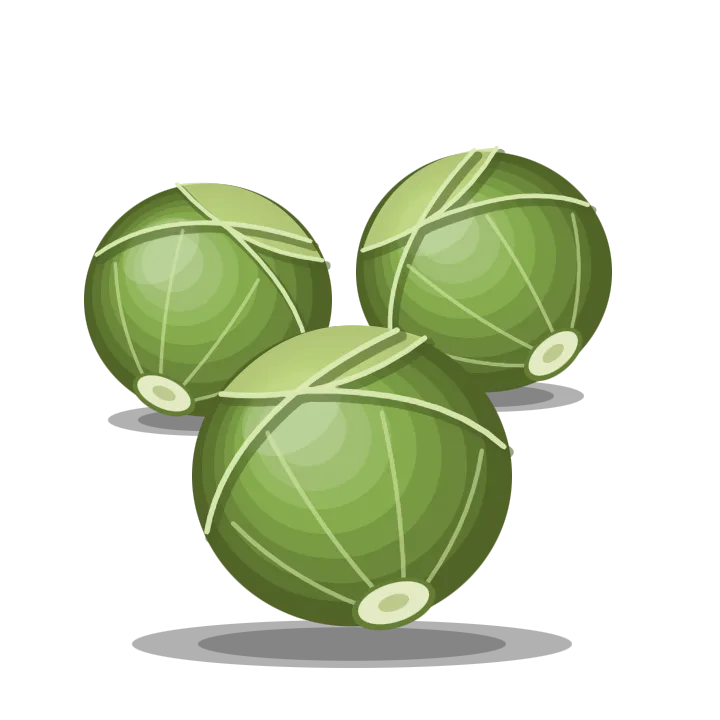
Brussels sprout
Brassica oleracea var. gemmifera
vegetable
Small tight heads, buds of a cabbage that carries them along its stalk; said to be grown near Brussels from the 13th century, they are first described in writing only in 1587. 100 g raw provide 85 mg of vitamin C, with glucosinolates, folate and vitamin K1.
- Origin
- Flanders (around Brussels)
- Season (United States)
- October to February · grows in your region
- Preparation
- Only the damaged outer leaves are removed; the leaves from the top of the plant are eaten too, like greens. Short cooking, steamed or roasted: it is long boiling that produces the sulfurous smell it is blamed for, by breaking down its glucosinolates. Most of its goitrogens go with cooking, even a short one.
- Molecules
- Lutein and zeaxanthin · Glucoraphanin → sulforaphane · Glucobrassicin → I3C · Vitamin C · Folates (B9) · Vitamin K1 · Insoluble fibers · Chlorophyll · CholineWhat slows things down Goitrogens
- Did you know?
- They grow in a helix along a stalk 60 cm to 1.2 m tall, ripening from bottom to top over several weeks.