
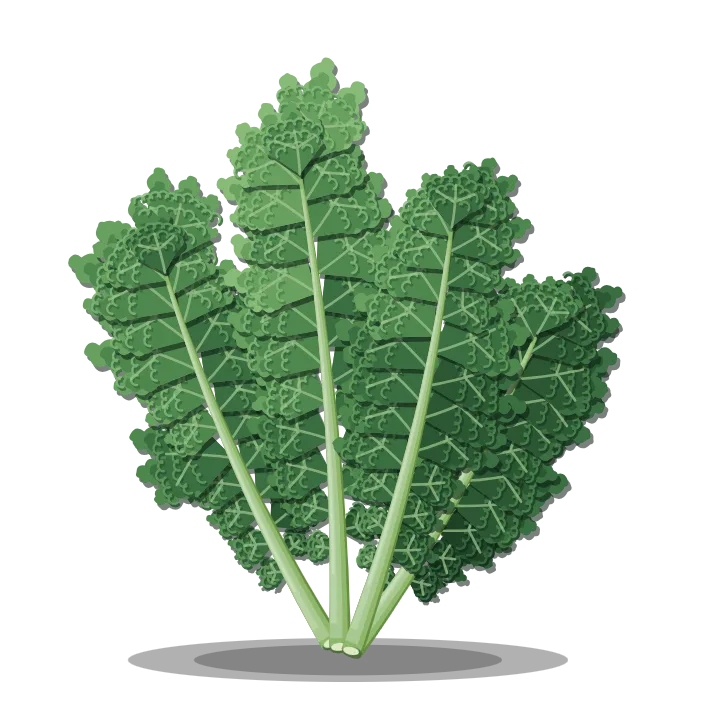
Kale
Brassica oleracea var. sabellica
leaf · vegetable
A curly, non-heading cabbage with deeply cut leaves, long a winter vegetable of Germany, Scotland, the Netherlands and Scandinavia. 100 g raw provide 93 mg of vitamin C and 254 mg of calcium, with lutein, beta-carotene and vitamin K1.
- Origin
- Eastern Mediterranean
- Season (United States)
- October to March · grows in your region
- Preparation
- The thick ribs are removed if tough; young leaves are eaten whole, even raw. Short steaming keeps its glucosinolates; long boiling carries them off. Most of its goitrogens go with cooking, even a short one.
- Molecules
- Flavonols (quercetin) · Beta-carotene (vitamin A) · Lutein and zeaxanthin · Glucoraphanin → sulforaphane · Glucobrassicin → I3C · Vitamin C · Vitamin K1 · Calcium · ChlorophyllIn small amounts, not counted LignansWhat slows things down Goitrogens
- Did you know?
- Well known on Roman tables, it was a staple in the Middle Ages, long before coming back into fashion as kale.