
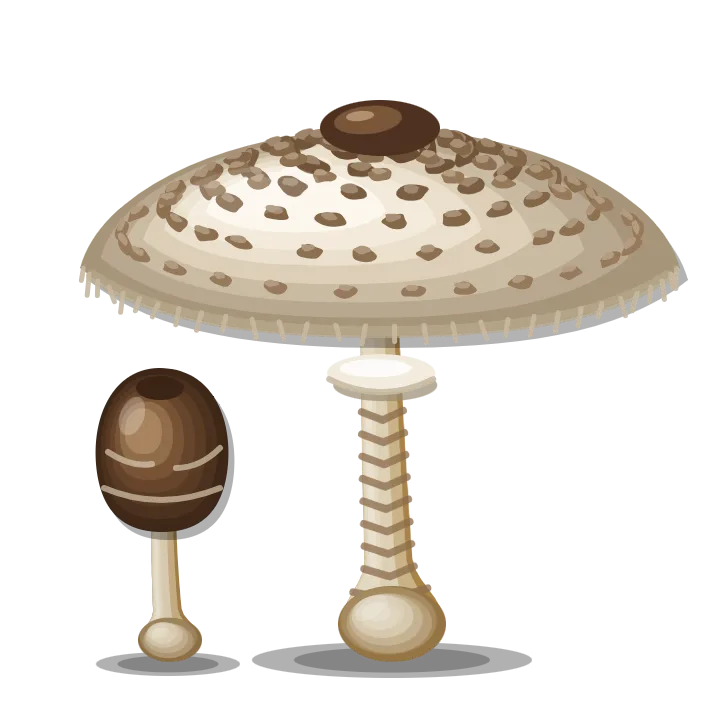
Parasol mushroom
Macrolepiota procera
mushroom
⚠️ Toxic look-alike
Never eat this mushroom unless you are certain it is not its toxic look-alike.
Small lepiotas (brownish-pink lepiota, Josserand's lepiota…) contain the same toxins as the death cap and kill people in Europe every year; when young, the panther cap looks like it too. An adult parasol mushroom has a cap wider than 10 cm, a stem mottled brown like snakeskin, a double ring that slides along the stem, and no volva at the base. A lepiota under 10 cm is never eaten. The first signs of fatal poisoning only appear 6 to 24 hours after the meal, when the liver is already damaged.
If in the slightest doubt, leave it. If you feel unwell after eating it, even several hours later, call Poison Control (1-800-222-1222) or 911.
A large mushroom of meadows and woodland edges, with a scaly brown cap, egg-shaped at first then spread like a parasol, with a central knob; a double ring that slides, a tall snakeskin-patterned stem. It provides beta-glucans.
- Origin
- Meadows and woodland edges of Europe
- Season (United States)
- August to October
- Preparation
- Always well cooked, and the stem goes in the bin: it is too fibrous. Pick it only once identified — small deadly lepiotas look like it. If you pick it yourself, have the mushroom checked by a pharmacist or a mycological society before eating it.
- Molecules
- Mushroom beta-glucansIn small amounts, not counted Ergothioneine
- Did you know?
- It is also called the tall lepiota: its stem is 10 to 30 cm tall, and its cap opens into a parasol that can reach 25 cm.